
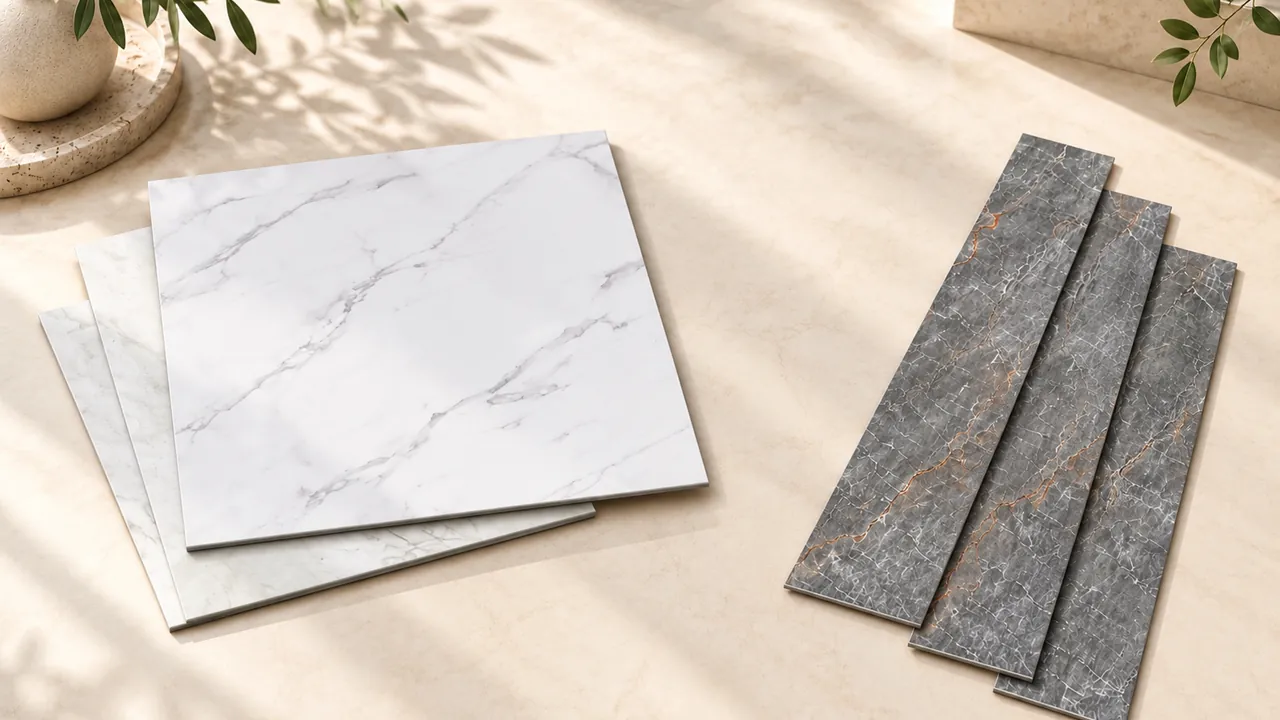
Compare the Two Supplied Floor Formats
A 60cm-square floor sticker and a 91.4 × 15.2cm floor plank require different layout and quantity planning. Read the selected item's material labels, actual thickness references and packing separately. Both references list self-adhesive fitting, but the subfloor, preparation and project requirements still need a product-specific discussion.
Start the comparison with the physical purchasing format. The number of pieces in a carton is not enough to compare two products, because the piece dimensions differ. A shared marble or wood-look description also does not make the materials, gauge or installation conditions identical. Keep the product identity attached to every specification line.
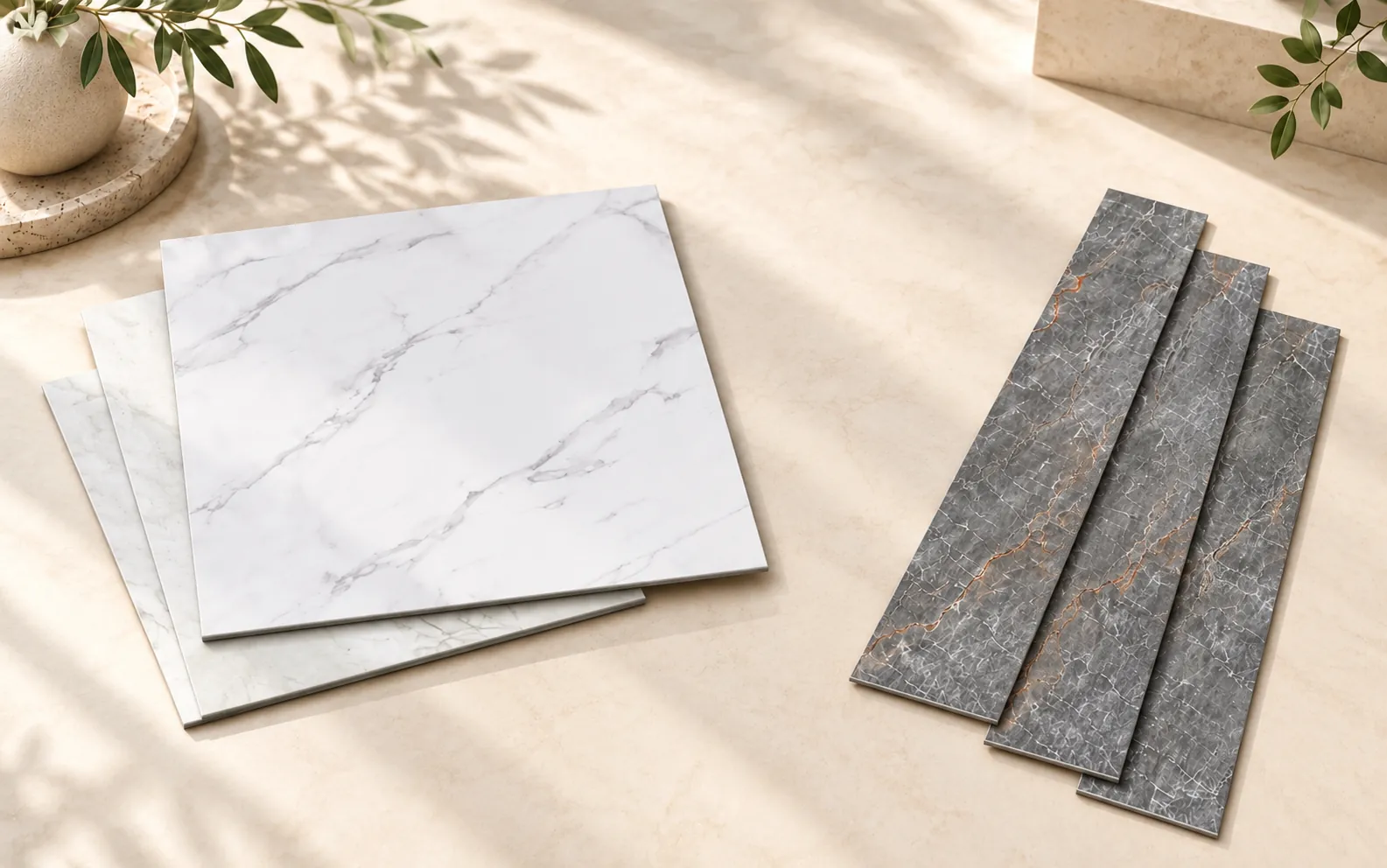
Grey/Golden Marble-Look Floor Sticker
The square floor-sticker reference is 60 × 60cm, with a listed 1.5mm format and the actual thickness choice “1.5mm around.” It uses wood-plastic composites/PVC material descriptions and is self-adhesive and peel-and-stick. Keep the approximate thickness wording when preparing the purchase specification.
Wood/Marble-Look Floor Plank
The narrow indoor floor-plank reference is 91.4 × 15.2cm, with 1.5mm/2mm thickness references. It is listed as SPC/PVC vinyl flooring with self-adhesive, peel-and-stick fitting and easy installation. Confirm the actual selected design and supplied thickness together.
How the Format Changes the Layout Question
A square format creates a different joint arrangement from a long, narrow plank. Show the room dimensions and the intended direction before comparing quantities. For the plank, indicate the direction in which the long edge is intended to run. For the square sticker, show any required alignment of the selected marble appearance. Do not infer a pattern-repeat measurement from the product's outline dimensions.
As a simple planning example, an unobstructed rectangle measuring 3.0 × 2.4m has an area of 7.2m². Using the stated 60cm-square format, a sketch can show five nominal squares across and four down. This is an illustration of the dimension relationship, not an installed-coverage promise or a purchasing recommendation for an actual floor. Real boundaries, cuts, selected design and fitting requirements still need review.
Record Approximate and Alternative Gauges Accurately
For the square sticker, write approximately 1.5mm rather than changing the actual “around” choice into a precise tolerance guarantee. If a project needs a defined dimensional tolerance, ask whether that requirement can be agreed. Do not assume that the displayed nominal value answers a separate tolerance question.
For the plank, keep both listed thickness references visible in the enquiry and ask which one is being quoted. Its actual design options are Multi and references 1 through 13; those selections do not establish a complete matrix of every design in both gauges. Record the confirmed design, thickness and full supplied format as one line.
Keep Material Labels With the Actual Product
The square sticker uses wood-plastic composites and PVC material descriptions. The plank is presented as SPC/PVC vinyl flooring, with PVC in its material field. Preserve the material wording attached to the selected reference when requesting clarification. A material abbreviation or appearance name does not establish an unlisted internal construction.
Appearance and Construction Answer Different Questions
Marble-look identifies a design appearance on the square sticker. Wood/marble design identifies the appearance direction offered by the plank reference. Neither description establishes that the covering is natural marble or a solid timber plank. Choose the visual reference, then confirm the actual supplied material and format for that choice.
If a purchasing specification requires a particular layer structure, wear-layer value, edge detail or other construction information, include it as a question for the selected product. The listed references do not provide a basis for adding a click-lock system, a quantified wear grade or a particular core architecture to the brief.
Read Ordinary Features at Product Scope
Both selected products include waterproof and eco-friendly features. Keep those ordinary functions attached to the chosen floor covering. They do not by themselves supply an emissions document, a tested commercial-use classification or an installed waterproofing system for the whole room.
For a project with a specified performance requirement, identify the required document or acceptance criterion in the enquiry. The evidence and acceptance guide explains how to compare any supplied document with the product, material and intended use. Do not transfer a report or performance statement from a different covering because its colour or design looks similar.
Keep the Selection Useful for Purchasing
A practical line item combines the product reference, actual design choice, material description, complete dimensions and supplied gauge. This allows the appearance and technical questions to be discussed together. An enquiry for “marble flooring, two cartons” leaves both the selected product and the required specification unclear.
Describe the Existing Floor Before Discussing Installation
Self-adhesive identifies a fitting feature, not universal compatibility with every existing floor. Before planning installation, describe the subfloor and ask for the selected product's actual preparation and fitting instructions. A clear description is more useful than asking whether it will “stick to anything.”
Send the Surface and Its Current Condition
Identify the underlying material and any existing finish or covering. Explain whether the proposed work is over an existing surface or on an exposed substrate. Include measured dimensions and relevant photographs or drawings through an agreed enquiry channel when they help communicate the situation.
Describe visible joints, uneven areas, surface damage, coatings and any known moisture concern. These are details to discuss, rather than an invitation to apply a single generic preparation method. Ask which conditions need resolving and which instructions apply to the selected sticker or plank.
State the Intended Use and Environment
The square sticker lists interior-floor decoration and renovation, including hotel, villa, apartment, office, school and mall applications. The plank lists indoor apartment and interior-floor decoration and renovation. Use those product-specific references as a starting point, then describe the actual space, expected use and any project requirements that need assessment.
Include exposure conditions relevant to the floor, such as a known wet-area requirement or a heating system. Ask about underfloor-heating compatibility and the necessary instructions if that system is present. No approved heating arrangement or permitted operating temperature should be assumed from the self-adhesive or waterproof description alone.
Confirm the Fitting Questions That Affect the Project
- Which substrate and existing finish are being considered?
- What preparation and fitting instructions apply to this exact product?
- Does the proposed environment require additional evidence or assessment?
- Which layout, edge or transition details need clarification?
- Should a product-specific fitting check be agreed before the larger work?
These questions help prepare an enquiry; they do not establish an installation method or a contractor's site assessment. Keep any actual fitting instructions and agreed trial conditions with the selected product record. The application guide and sample and approval guide provide the related buyer checklists.
Read Packing, Warranty and Quantity Separately
The square sticker lists 28 pieces per carton. The narrow plank lists 72 pieces per carton. These counts describe two different packing arrangements; they are not interchangeable order units and do not establish either product's minimum order quantity.
Why Piece Count Alone Is Misleading
Using the stated dimensions, one 0.60 × 0.60m square has 0.36m² gross format area. Multiplying by 28 gives 10.08m² of gross product area per listed carton. One 0.914 × 0.152m plank has 0.138928m² gross format area; 72 such pieces give approximately 10.00m².
The two nominal carton-area totals are therefore close, even though the piece counts differ substantially. This arithmetic illustrates why the count needs its product dimensions. It does not establish the usable area after cuts, the required layout allowance, a final purchase quantity or that the two products can substitute for one another.
Show the measured floor, intended arrangement and requested order quantity separately. Ask how the selected design, carton quantities and any additional allowance will be handled. Use the order-unit guide when preparing a measured-area brief, and keep the actual MOQ as a question if it is not supplied.
Warranty Duration Is Also Product-Specific
The square floor sticker lists a one-year warranty. The plank lists five years. Preserve that distinction when comparing the references, then ask what coverage, exclusions and reporting conditions apply to the actual order. A duration alone does not explain the remedy or the claim procedure.
The support descriptions also differ. Graphic-design capability is listed for the square sticker, while the plank lists online technical support, graphic design and cross-category consolidation. Ask about the selected product's actual support arrangement rather than treating every floor covering as carrying the same service package.
Prepare a Floor-Covering RFQ That Keeps the Decisions Together
A useful floor enquiry brings the reference, format, measured surface and quantity into one readable record. Start with the product link, then distinguish the facts already selected from the conditions you need confirmed. This helps a quotation address the actual floor rather than an approximate design description.
- Selected reference
- Exact product and actual design choice, or the catalogue reference to be agreed.
- Full format
- Width, length and approximate or alternative thickness references, with the supplied gauge to confirm.
- Measured layout
- Room dimensions, openings, intended direction and any important pattern or edge questions.
- Subfloor
- Underlying material, current finish, condition and relevant environmental details.
- Quantity
- Requested pieces or cartons per design, separated from measured area and any MOQ question.
- Order requirements
- Destination, requested date, approval needs and required performance information.
For the square sticker, retain “approximately 1.5mm” in the record. For the plank, confirm the supplied gauge rather than selecting both 1.5mm and 2mm by assumption. Keep the stated carton count with the exact product so that any change of format also prompts a review of the quantity calculation.
Before order approval, compare the quotation with the selected design, complete dimensions, packing and fitting information. Ask for any unresolved evidence or support conditions to be clarified. A requested date remains a planning input until the actual order timing is agreed.
Use the main RFQ checklist to send these details together. The purpose is a clear, product-specific discussion of the floor covering and its intended use, with the remaining decisions visible.